There are only 55 days from now (29/08/2015) and this year's Ride to Conquer Cancer benefiting the Peter Mac hospital.
With your generous donations, I have reached the trigger level required to enter the ride and I am very grateful to all of you who have supported me again to get this far. As with previous years, I would be as grateful for any donations now as I was when I started. All donations go directly the Peter Mac and their Cancer research program. There is no waste or cost from the charity organisation. A dollar donated is a dollar to the research fund. So if you want to donate and you can afford to, then please do so. I promise to reply in person to everyone who makes a donation.
It has been winter for a while now in Melbourne - in fact we have only two days before spring is officially sprung - so I thought I'd give a flavour of a typical winter morning for me over the last 3 months or so.
Wishing the very best to you and yours.
John.
It's 0445, I've been aware of the time on my bedside clock for a while now. Seeing the time advance in 20 min chunks of dozing. The room is unlit and it will be two and half hours before sunrise. Home renovations mean that we have no curtains in our room, so streetlights, the moon and stars cast some light, but it's still too dark to see much. It's warm under the doona but the air is chilled enough in the room that my nose is cold.
And I'm asking myself: do I really want to ride again this morning?
I listen intently for any sound of rain. If it's lashing down, then I'm not going out. Rule #9 and Rule #5 not withstanding. Wet roads are slippery, car drivers less predictable, visibility worse and punctures more frequent. And the wet makes the cold much worse, especially in the gap between getting home from training and heading out again in wet gear on the bike to commute to work.
This morning there's no rain to be heard.
I want to switch on my phone to check the rain radar. I wonder if I can switch it on without the noise and illumination waking Sandra (I can't, but I always wonder if I can). I reach for my phone on the bedside table, unplugging the recharge cable and holding down the power button until the screen lights up with its boot up sequence. I place the phone face down on the mattress next to me, dimming the glow but risking the vibration of incoming messages travelling through the mattress and waking Sandra.
Once the phone has finished booting up, I open the weather app. Scattered showers, southerly wind, 7C feels like 3C. Sandra stirs next to me. I've woken her up slightly. I always wake her up and I always try not to.
Its 0500. Time to make a decision. I get up and as quietly and quickly as I can get to the bathroom, lighting my way with the screen of my phone. If I've planned this ride, my kit is on the warm towel rail to reduce the challenge of pulling on cold clothing. Putting on a cold heart rate monitor is particularly unpleasant, with the cold plastic needing to be dampened to ensure good electrical contact. I pull on three layers of upper body clothing, cycling nicks, leg warmers and winter thickness socks and make my way to the kitchen.
A bowl of muesli and a quick cup of tea later I pull on my cap, helmet, clear glasses, two pairs of gloves and shoe covers. Filling a drink bottle, I pick up my lights from the recharge points, grab the Garmin and head off outside into the dark and my bike.
At 0530 I start my ride in the cold dark air, shivering until the exercise overcomes the cold air passing through my layers of clothing, trying to ignore the spray coming up from the road onto my boots and up into the beam of my light, creating my very own shower to ride into. An hour and a half of intermittently hard exercise is ahead of me.
Winter sucks.
Shade Seekers On Buller

Shade Seekers On Buller
Saturday, 29 August 2015

Sunday, 26 July 2015
Winter is here
Another Chapter in my Father's Journey
I know from many responses to these posts that there are those amongst you that are going through, or have gone through, similar experience to mine. I know that at times the experience can be overwhelming. For all of you I thought I would offer an epilogue of my story to date.My Mother died of cancer on July 18 last year in the UK with my Father and Sister at her side. I've written before about making the best you can of the time you have and we did our best to achieve that in the 10 months we had from diagnosis. For us, it seemed right that less time went into thinking about the time after than the time you still have. There were however, many quiet conversations between my Mother and Father in the wee small hours and a few that I had when I was staying with them and keeping my Mother company through the night.
At least at some level my Father had shared plans with my Mother to get a mini recreational vehicle (a "bongo" to be UK precise), and to travel with Rogue (their dog) to highest points of all the parts in England that he had yet to reach. I'm not sure if he shared another aspect of the plan that included travelling with her ashes in a jar in the bongo - it's hard to imagine how that would work in conversation - but then these situations make possible what would otherwise be impossible conversations. In years gone by he'd ticked off similar lists of all the Wainwright Hills (England's Lake District mostly), all the Scottish Hills (over 4000ft) and (I think) the same is true of the Welsh Hills. So this felt about as right as any plan could in the circumstances.
The last 12 months since July 18 have been up and down, or more accurately very down and now more up. Over the months he's gradually built a new life that he never expected to have, or to have to do. Along the way he's managed to connect with old and new friends and each has rallied round. Now in our video calls he tells me of his busy social calendar with Jazz on a Wednesday, rambling with a large group (50 or so apparently), swimming with his school friend Peter, and this week catching up with Burt and his new partner. Burt has been a great comfort to my Father, both as a friend of some 40 years and as an example of someone who also lost their wife to illness and after time re-found a life and eventually a new partner. Burt's undiminished passion for life, the hills, great beer and even greater curries has been an inspiration, so much so that my father was complaining about a hangover on our last call.
At times grief can seem insurmountable and overwhelming, it can stretch into achingly empty and unending hours, days and weeks. As Joan Didion wrote
"Grief, when it comes, is nothing like we expect it to be. … Grief has no distance. Grief comes in waves, paroxysms, sudden apprehensions that weaken the knees and blind the eyes and obliterate the dailiness of life. Virtually everyone who has ever experienced grief mentions this phenomenon of “waves.”
It took time for my Father to start to come to terms with his new life, and no doubt will take more. Life for my Father won't be the same again, but he is gradually opening and writing the next chapter of his life as my Sister and I are with ours.
It is a humanist principle that we each have a responsibility to live a good life, and the freedom and obligation to decide what that good life should be.
I hope that you and those you love get to make chance to make the best choices that you can.
Here's the Bongo:

[Venskab means friendship in Danish and was the name of the barn my parents converted]

... and this is Rogue, a lurcher, on Brown Willy, Dartmoor

... Rogue on another Tor in Devon
A bit about cycling in the cold
Winter in Melbourne is nowhere near as harsh as the Northern climes of my youth. Cycling the 4km to school in Kirkcaldy during winter was far harsher than anything Melbourne has to offer. It was usually frosty, occasionally icy and every winter would offer several days of snow to contend with. Back then of course, I thought my steel 10-speed road bike was the bees knees, and I had no thought of aerodynamics or drag with my large winter coat and tucked in trousers catching more air than Kelly Slater.
The years that I've now spent in Australia have seen me adjust to the climate, at least in terms of expectations. Right now the average Melbourne minimum of 7C and average maximum of 14C feel pretty chilly. Kirkcaldy's numbers are 0C and 5.8C by the way. People in Kirkcaldy were tough, they too would wear a vest as their only top as some do here in Melbourne, but there was no-way that was going to get them a sun tan. Hypothermia maybe, sun tan no.
Here in Melbourne's winter I join other skinny lycra clad cyclists in complaining about the cold, dark weather. On a recent ride Grant and I watched the temperature reading drop down to 1.2C as we rode through the morning frost towards the Dandenongs. Not for the first time this winter, we found that the temperature rose as we rode up the hills to Sassafrass and out of the cold air that had sunk into the valley. Basically it's all a question of getting the clothing right - even then though its hard to get it right on the way up and the way down. You get hot on the way up, and super chilled on the way down. On several descents I've got so cold that my violent shivers make handling the bike very difficult and threaten to take me off the road. To which the real cyclists would just shrug and say "harden up" [there is a longer phrase in use, refer to Rule #5].
Where am I in my journey to this year's RTCC?
Thanks to those that have already donated I am at about 80% of my target so I'm still very keen to receive any donations that others may be planning to make.
As an incentive (and a test to see if anyone reads to the end of these posts), I could re-instate the "will shave legs for charity donation" offer. Last time I did this it raised several hundred dollars and I discovered that shaved legs made me no faster, but did make trousers feel weird and gave me no purchase on the duvet when Sandra pulled it to her side. But I'll do it again for this cause!
Until the next time,
John.
Saturday, 30 May 2015
John's Ride to Conquer Cancer 2015: Where your dollars go and surprisingly healthy elephants
As I write this post, I’m just over halfway to my donation target to participate in this year’s Ride To Conquer Cancer. Many many thanks to those of you who have donated already. If you plan to donate, please do - I need to reach a minimum level before the ride in October.
In this update I thought I’d share some information on how your dollars are spent in cancer research by Peter Mac, give an example of one of the more exotic areas of research going on in the world, and finish with a bit of cycling.
A few weeks ago Peter Mac shared a summary of how the money donated through the Ride to Conquer Cancer goes towards their research programs. This is the summary they sent me:
- Ride dollars are providing Peter Mac’s researchers with access to state-of-the-art genomic technology platforms, and providing experts to help conduct genomic experiments. Genomic technologies allow researchers to decode or count DNA and RNA molecules to find differences that exist between normal and diseased cells. As cancer is a genetic disease caused by mutations that are either inherited or acquired during life, genomic technologies are extremely powerful tools to discovering mutations in genes implicated in cancer.
- Peter Mac invests funds raised through The Ride to help support the Bioinformatics Facility, which processes massive volumes of data produced by our Molecular Genomics facility.
- Ride dollars are giving researchers access to high-powered microscopes which significantly magnify a single cancer cell to determine causes and treatments.
- Ride dollars support the Peter Mac fly lab, which allows researchers to refine their most promising research into human trials through the use of tiny Drosophila melanogaster (fly) models as pre-clinical models.
The Elephant is in the room and surprisingly healthy:
I am lucky enough to count one of Peter Mac’s worldwide Cancer Research Specialists as a close friend and riding buddy. Our ride discussions are a mix of cycling chatter, coffee and cafe choices, family and work experiences, and occasionally an interesting aspect of the research world. I thought I’d share one example…On one recent ride I was introduced to Peto’s paradox: if every cell in an animal has an equal chance of developing cancer we would have no large, long lived animals, like elephants and whales. The observation is that animals with long lifespans and large numbers of cells (like elephants) have very good cancer prevention mechanisms, much better than ours. The tantalising opportunity is that if we can learn how, perhaps we can mimic the approach. Other than being a likely question for ‘QI’, this is one example of the lengths and breadths that research scientists are exploring to find ways to find preventions and cures for cancer.
Riding
In terms of my riding, I’ve been cutting back to a less demanding weekly schedule since my 3 Peaks epic. I’m doing a local group ride quite frequently (the “Maling Room Ride”) and not doing as many long rides - still means something like 100 - 250 km per week, so I guess that’s still quite a lot for most normal people!
Stay well, till the next time,
John
Friday, 24 April 2015
Email Post #2 from the RTCC 2015:
[copy of the email posted out on 22 April 2015]
Dear All,
Last month I wrote my first email about my journey to (hopefully) participate in this year’s Ride to Conquer Cancer benefiting the Peter Mac Hospital. In that message I explained why I decided to enter again this year.
I've been touched again by the generosity of those who have sponsored me with a donation since I wrote that email. As ever, I need to make a target before I can participate in the ride and every donation helps me to this goal. If you can donate, please do.
Each year my personal motivation has been different, but the fundamental reason remains the same: the work done by the very good people at the Peter Mac benefits us all (wherever you live) and this event is the primary source of independent funding for their work.
The fact that in Australia 1 in 2 of us will contract cancer is daunting. By the time we reach an early adult age, we will already know someone who has been touched by cancer and in far too many cases, the experience will have been personal. The longer we live, the more likely that it will be us.
This event centres around a 2 day, over 200 km cycle ride that for many is a huge achievement. For many who are not cyclists, or who are suffering from or recovering from cancer, the ride itself is a mountain to overcome and they have my deep respect.
I've been lucky enough and healthy enough to develop a somewhat obsessive relationship with cycling. In my blog I've written up my account of my experiences of participating in this year’s Falls Creek 3 Peaks ride. A ride that covers 235 km and has over 4000m of climbing in a single day in the Victorian Alps. You can read about that in my previous post here:
http://petermacrtcc.blogspot.com.au/2015/04/the-three-peaks-march-8-2015.html
If you get a chance to read this, you’ll can see what I mean about obsessive! (there are pictures by the way).
An observation that I’d like to offer is that I was able to spend months getting ready for this challenge: I was lucky to be able to spend the time, not to get an injury, not have any accidents, nor have bad weather get in the way on the day. People who are diagnosed with cancer have no time to prepare for their challenge, their mountain climbs start the moment that the diagnosis is given.
Cancer research is finding why cancer occurs and grows. Its about finding ways to get earlier diagnosis and better treatment options with better quality results. Someday the researchers hope that we won’t have to face the challenge of cancer, right now it improves the chances of more of us overcoming the challenge.
Wishing you and yours the very best of health
John.
Monday, 20 April 2015
The Three Peaks - March 8 2015
I bought my road bike back in November of 2012.
It was a bargain special Giant Advanced TCR 0 with Di2 Ultegra (an electronic gear shifting system). It was a bargain considering the one step down from the top components and full carbon frame, but people who haven't got the cycling bug might think it expensive. It was (and is) the best bike I've ever owned. Giant is not a fashionable bike brand, more the Ford of the bike industry with a range running from the "Ka" with training wheels to a GT40. My bike in its factory fresh paint job of Grey and Blue has never topped the fashion stakes, but that kind of suites me!
Standing in the shop I remember asking the assistant whether the bike was the right kind of bike to do the alpine climbs in Victoria. Was the bike "good enough"? Silly question. The right question to ask, but hard even for a genetically positively disposed sales person to answer was "am I good enough to do the alpine climbs in Victoria?"
Even back then in my embryonic riding state, I was aware of the Three Peaks challenge. A single day ride set in the Victorian Alps that has three climbs, covers 235km and has over 4000m of climbing. It has been favourably compared to a day on one of the Grand Tours. Reality check here, this is a ride that compares to a single day on a grand tour. A single day of a Grand Tour that is measured in days and weeks of back to back riding... chapeau to the pros.
To give this ride some more context, it is the only Australian ride in Global Cycling Network's top ten best Sportive rides in the world.
This is the ride in satellite view:
 |
| Map of the 3 Peaks Route |
 |
| 3 Peaks Elevation Profile |
Now in mid April of 2015 I've done some 30,000 kilometres on my Giant, including the 235 of the three peaks on 8 March. That's more kilometres than I've driven a car in the same time. I've replaced chains (twice), cassettes (twice), cranks once (from 53-39 to 50-34 compact), wheels once (a rim cracked), and tyres and tubes innumerable times.
I spent months training for this event. I registered in October 2014, hoping to ride with a close friend, let's call him Bernard after Bernard Hinault. Bernard over the last few years has developed the same love of road cycling in the hills as I have. We decided we weren't ready for the 3 Peaks in 2014, but that we'd register for the ride in 2015.
Cancer rears its head again
As soon as entries opened in October 2014, I signed up and shared the news. The first signs that something was up was when Bernard told me that he wouldn't be able to train as much over summer as he'd hoped.I thought this was pressure of work and international travel. However the plans for a joint ride were dashed when he told me days later that he had prostrate cancer and that he would have to stop cycling for some time.
Luckily he had an early diagnosis and the best access to care available in Victoria. With successful surgery and no signs of spreading, the cancer has been removed. He's now back on the bike and after a summer of building up is fitter than ever.
Stoic and incredibly matter of fact, in some ways he's not changed and yet he'll never be the same - you don't get bits of you removed without some lasting side-effects,
Training, training and more training
So I spent the first half of the Australian summer training on my own. My week days were spent finding days to do early morning repeat loops of the "Kew Boulevard" loop (see frame below) and finding time for longer rides at weekends. "Kew Boulevard x 3" became a staple Strava post for me.The aim was for 250km+ per week to build a base. Before Christmas and as soon as his surgery recovery allowed, Bernard joined me on the bike again. We worked out a weekend routine where we'd climb hills at our own pace and I'd turn at the top, head down and ride with him from wherever he'd reached. This way I got more metres of climbing and distance, and I could check on his progress (which was rapidly improving making my turn-arounds shorter each time). He even managed to do the four Alpine climbs between Christmas and New Year with the Hells 500 arranged "7 peaks domestique series". This gave us a glorious three days of riding in the Alps from our base in Bright. As the French leaning cyclists would say "chapeau" Bernard, chapeau.
Towards March I started to do weekly repeats of the "Crucifix" ride in the Dandedong hills. From my home this makes a 130km ride with 2500m of climbing (4 main climbs, lots of smaller ones). Despite this being normally recognised as a reasonably hard day in the hills, it was only just over half of what the 3 peaks would demand. By now my weekly riding was more like 350 to 400km than 250 to 300km.
Overall I had a pretty damn good run at the training from January on to March. I am grateful that my family let me spend so many selfish hours on my bike, that my work didn't require me compromise too much, and that I didn't get, or give myself, any injuries.
You can see the impact of training over the last two years on my "fitness and freshness" graph from Strava below. The dark line is (theoretical) fitness, the jagged light grey line is fatigue, the bars at the bottom are distances ridden per week. With frequent long rides, fatigue increases but so does fitness. Take a break and freshness increases, fatigue falls and, slowly. so does fitness. My "fitness" prior to the 3 Peaks was around 80, I've come down to "67" since then...
 |
| Strava's "fitness and freshness" graph |
Meet Greg and The Dark Knight
During the last few weeks before March 8, the dark early morning loneliness of the long distance rider was getting to me, and I decided to join in with a local "group" ride that started only a few km from my house, the Maling Room Ride (MRR). Started in 2009 and staying popular since then, it was "only" a 28km loop starting at 6am, but it had some hills and I could use it to intersperse my Kew Boulevard and Crucifix repeat days.On the ride I made friends with the voluble Heath ("The Dark Knight") and the more taciturn Greg (just "Greg" although TDK calls him "Uncle"), both of whom were also doing the 3 Peaks ride. Greg had joined the Cycling Inform training program and had already done a 235 km hilly ride to practise, TDK was racing criterion grade C (moving to B) and had done the ride two years before in the blistering heat of 2013 (when a third of the field did not finish due to heat exhaustion and dehydration). He had also done the 7 peaks in 6 days over mid summer this season. I was suitably impressed and worried about my own efforts.
The Wednesday and Friday Maling Room Rides "recovery" sessions became a staple, as did coffee with TDK and Greg and the rest of their group within a group after the ride.
Grown men do cry
In my mind this event loomed larger than any endurance event that I've ever done. From walking the "Coast to Coast" over two weeks as a young teenager, to doing the "Welsh Three Thousands" in 24 hours on two occasions as a habitually fit young man, to more recently doing the Port Phillip "Around the Bay in an Day" ride on my mountain bike, foolishly keeping up with a group of fast roadies until hitting the wall at 80km (with another 130km of struggling to go). Each of these seemed easier (or maybe I was just younger).Every single description of the 3 peaks ride that I read contained words like "brutal" and "torture". One of my fellow Shade Seekers had done the ride and confessed that he was crying during the last ascent before finishing in 10 hours and five minutes (and that 5 minutes hurts, as you'll find out later). He was asked by a passing police officer "why do you guys do this to yourselves?"
He wasn't the only one who's cried trying to climb the back of Falls Creek with 200+km in their legs and he won't be the last.
The challenge within the challenge
To complete the ride demands that you finish within 13 hours from the start time. This is a safety precaution rather than a macho target. By the time it gets to around 7.30pm in Victoria in March the light is fading fast and if the weather takes a turn for the worse things could get nasty very quickly for the exhausted riders still out on the road. Throughout the day, two riders ("the lantern rouge"), ride at the back of the group at 13 hour pace, if they catch you you are encouraged to gracefully accept that your ride is over and that you should wait for the "sag" wagon. If you can't accept gracefully, you will still be told you have to stop. It's probably the hardest job to do for the event organisers. No-one wants to tell a fellow rider that their day is done.If you finish within 13 hours you get a finishers jersey. You have to finish to get the jersey. If you finish with 10 hours you get a finishers jersey with "<10" added. No matter how much below 10 hours you finish in, you only get the <10 jersey. There is no <9, and no <8 (and there are some riders who finish incredibly in just over 7 hours and 30 minutes). Everyone who thinks they have a chance, wants the <10 jersey. Badly. The event (its not meant to be a race) organisers publish helpful tables of times to aim for depending on your target finishing time. The times detail how long each section should taken and how long you can afford to stop at each break point. If you have a lower target time, you can't afford to stop so much. You'll see the 8 hour target has only 10 minutes max of stopping time for the whole ride. Brutal indeed.
 |
| 3 Peaks Target Times |
Eat before you're hungry, drink before you're dry
As an example of the obsession... in the weeks before the ride I started paying attention to how much food and fluid I was consuming while riding. Keeping track of how many grams of carbohydrate per hour, and how many millilitres of water. I bought special gels and electrolytic food powders from Wiggle (online cycle store, catnip for cyclists). I started keeping a spreadsheet of rides, tracking distance, climbing, fluid and carbohydrate consumed and comparing the "energy in" with the Strava calculated "energy consumed" (each Strava recorded ride tells you how many calories it thinks you've burned).
The gels had caffeine in them (I hadn't realised this on purchase). Initially I thought this was a good idea (hard to find time and a cafe for a good coffee during the 3 peaks ride), then I became worried about too much caffeine. Each sachet has around half a shot of espresso of caffeine... I normally have a double shot at the start of the day, so four gels would be a "normal" intake. How many gels would I need for the ride?
The gels had caffeine in them (I hadn't realised this on purchase). Initially I thought this was a good idea (hard to find time and a cafe for a good coffee during the 3 peaks ride), then I became worried about too much caffeine. Each sachet has around half a shot of espresso of caffeine... I normally have a double shot at the start of the day, so four gels would be a "normal" intake. How many gels would I need for the ride?
Turns out the like most recreational cyclists, I eat and drank too little on most of my rides. You can get away with that on short rides, but on day long ride like the 3 peaks, you're going to end in serious calorie debt and likely bonk out of the ride (not pleasant). So you are going to have to manage your intake as best you can to get round. Even if you do your best to consume bars, gels and real food at the lunch break, you just can't consume as many calories as you'll burn, let alone digest them (at least I can't!).
There's no room at the inn, but you can stay at the Ritz
6 weeks before the ride I realised I hadn't booked accommodation. Earlier in the year Bernard and his colleagues had suggested they might make the trip to Falls to encourage me during the weekend. As it turned out, another trip to the mountains for a walking weekend was organised. Belatedly I realised with only weeks to go that I hadn't yet booked accommodation. So I called up the tourist office at Falls and asked if they still had any rooms. "Yes" was the encouraging reply, but they only had rooms with double beds (or two twins), so I'd have to pay extra. How much extra? When they said $660, I thought that wasn't too bad. When they told me that was per night, and that I'd have to book three nights (not the two I'd planned), I was suddenly staring down the barrel of a ~$2000 stay for a one day ride. Asking if there were any other choices, I was told that the hotel had rooms, at $1100 per night! Thinking I could fly to Saint Moritz and stay for less than my one day ride would now cost, I said I'd think about it.The Falls Creek mountain resort was full to the brim with 2000 or so cyclists, friends and family. I also felt (perhaps wrongly) that the resort was cashing in on the off season bonanza with prices equal to and possibly exceeding peak winter rates. The alternative was to stay in the valley and drive up at 4.30am on the morning of the ride, and then drive down again after. Making a long day longer and driving down again after was a worrying proposition not knowing what state I'd be in.
Thank goodness for online cycling forums. I searched the Bicycle Network forum and found an advert for a room at Falls. Contacting Simon who put me in touch with Peter, the owner, and the room was confirmed as available and had two bunk beds in it. Things were looking up. Even if Sandra came I was only looking at $550 for the accommodation. Peter had let the apartment to his cycling buddy Simon and his wife Cath. Simon was riding and to my great relief and pleasure, Sandra agreed to come for the weekend. For Sandra it was going to be a relaxing weekend at a resort in the Alps (hopefully). Time to catch up with the reading, embroidery and just being away from the hustle and bustle of a busy family life.
But what would the apartment and Simon and Cath turn out to be like? Brilliant in both instances as it turned out.
Under Pressure
Thinking about a sub 10 was a mistake. By the time the actual weekend came around I realised that I should have been focusing on finishing, measuring out my efforts and enjoying the ride even. Not getting hung up on a fast time.Good riders that I'd met over the past few weeks and months had come close, I couldn't seem to find any who'd cracked 10 hours, except for the "pro" or nearly pro riders that I knew through CharterMason. When the weekend loomed I was nervous as all hell about having set my own expectations for my time, expectations that friends also had of me and shared with me via encouraging text messages.
I'd managed to put myself under unnecessary pressure.
Simon and Cath are simply superb
I"d packed all my gear the Thursday night before - putting in all the wet, warm and hot weather gear as well as the bike in the back of the car so that Sandra could pick me up straight from work. With the uncertainty of the weather in the Alps, we were encouraged to bring our full range of clothing. We drove on Friday evening, stopping for a good pizza in the Victorian Alpine town of Myrtelford made picturesque by the setting sun, a local wedding and festival, before heading up and up towards Falls.I like to drive reasonably quickly, but clearly not as quickly as some heading up to Falls. Interestingly, it was the cars with bikes on their roofs that were most impatient - managing to give a bad name to car drivers and cyclists in one gesture. I had to reassure Sandra that it wasn't our tyres squealing as we climbed the mountain pass.
On our quite late arrival at the resort, Simon came out to help us get our gear (and my bike) into the apartment. Cathy was already in bed. Simon then came down in the car with me to the car park and walked back with me to the apartment, solid bloke!
The Saturday morning (7 March) proved that the apartment was sunny, very comfortable and brilliantly located (25m from the pub), and to top all that, Simon and Cath were very pleasant company.
Simon and I went to get our bikes checked for registration (mandatory mechanical check including brakes and lights) and got our valet bags for the ride. The ride is very well organised with several drink and food stops, three of which allow you to send a prepared valet bag ahead to be waiting for you at the stop. The main stop is the lunch stop at Dinner Plain, at which you are encouraged to send a bag with dry clothes to change into in case the weather had turned nasty.
In my case, I packed my three bags with two sachets of the drink/food powder and two gels each. During the day I caught up with TDK and Greg and we agreed to book a large table at the pub for Sunday night for our extended group of riders, friends and partners.
Later that Saturday afternoon, Simon and I went for a ride to make sure we, and the bikes, were in full working order. A 50km hilly route survey ride to Trapyard Gap and back was probably too much, but we decided we could blame or praise the ride the day before depending on how we went on Sunday. At least we knew what the ride from Trapyard Gap back to the resort was like.
 |
| Selfie with skewy cap and glasses at Trapyard Gap |
Later that evening we attended the briefing where various event organisers, riders and officials gave us a run down of what to expect. One prophetic warning was to take it easy on the descents, particularly the Towonga Gap descent with two awkward off camber right hand bends.
 |
| The Guide Riders Show Their Target Times, Lantern Rouge at the rear in red |
That evening we all eat pasta, Simon and I out of tradition, Sandra and Cath in support. The weather forecast for Sunday was good to great, cool in the morning (6C), calm with winds gradually increasing during the afternoon and a high of 23C at Falls Creek. Some headwinds as we came back into the Falls resort, but no rain, hail or fire risk.
The day of the ride
A sleepless night spent checking the clock every hour finally gave way to a 5am get up. During the night I decided I should put the large bright front light on (a weight penalty of 300g) as I wasn't looking forward to starting the day with a descent in the semi-dark with over a thousand unknown (to me) cyclists. I thought I might need more than a simple flasher to light my way, even if I wouldn't be able to get rid of the light until the top of Hotham, some 100km later.The morning was a nervy mixture of porridge, tea and final bike preparation. I put on my over booties (Sandra say's they look like Smurf shoes), wore two layers of base clothing under my CharterMason top, my arm warming sleeves and an over vest. I'd packed my long fingered gloves in the valet back destined for lunch in case it was cold at the top of Hotham. I knew the start of the ride would be cold with a 30km descent at dawn.
You could tell we were nervous when we exited the apartment as it took a fellow cyclist (not me) to point out to Simon that he wasn't wearing his helmet as we waited in the cold pre-dawn dark for the girls to come out.
Simon suitably helmeted, we rolled to the start. First decision was how ambitious we felt. There were three waves of start times. Wave 1 (sub 9 hours), Wave 2 (9-10 hours), and Wave 3 ( > 10 hours). Time to put your hat in the ring. I gradually worked my through hundreds of cyclists to get to the back of Wave 2. Simon joined me and to my surprise I found my fellow Maling Room Ride companions, TDK and Greg, next to me too. In all, some 1700 riders would be starting the ride that day out of 1850 total registrations.
We were all pretty quiet except for occasional nervous chatter. We'd all decided that we'd go at our own pace, if we were together then that would be fine. We didn't want to put each other under pressure if one of us felt strong and wanted to go faster, or one of us felt weak and wanted to go slower. You just can't tell how you'll feel on the day, and its a long, long, day.
 |
| View from the back of the Wave 2 queue |
 |
| A nervous cyclist pondering the day ahead |
Finally Wave 1 gets sent off at 6:35 and very gradually Wave 2 shuffles closer to the start line. By the time I crossed the start it was 6:50, but total time only starts when you cross, so its not too bad. It was easily light enough not to need my extra light and I was pretty cold having spent an hour waiting to get rolling.
The front of Falls Creek descent to Mount Beauty is one of my favourite descents, the road surface is good all the way, the bends don't sharpen unexpectedly and the cambers are fine. I'd never done it with 1700 fellow riders on a closed road though. Descending in such a mass of people is interesting and you have to keep your wits about you. The distinctive squeal of brakes on carbon fibre rims heightens the tension at each bend (alloys like mine are relatively silent). It turned out that TDK, Greg, Simon and I were far more confident descending than those who'd put themselves nearer the front. We gradually overtook a hundred riders or more with only a couple going past us. Most of the time we were free-wheeling which was causing me to get even colder. There is brief respite of pedalling at the Bogong village with some short climbs, but mostly its downhill for 30 km. By the time we reached the town of Mount Beauty I was shaking with cold, making bike control difficult. Thankfully, the real pedalling was about to begin.
The road-sides of Mount Beauty were filled with cyclists dumping their extra layers of clothing, Jackets and over clothes worn for the descent were being abandoned behind trees to be picked up later (by them or their support crew). Simon and I rode on passed this curious scene, me still trying to get some heat into my body and unwilling (and unprepared) to shed any layers.
The climb up Towonga Gap (Length: 7.6km, Average gradient: 6.3%, Elevation gain: 479m) is the shortest, and easiest, climb of the Three Peaks. On a closed road, surrounded by other cyclists, I just focused on keeping my pace at a comfortable level, disregarding the pace of those around me. My target was to keep my heart rate below 155 BPM for the whole ride to make sure that I didn't burn the candle too hard or too soon. On the way up one of the riders near me (noticeable as she was tall enough to have a saddle as high as mine) declared she would jump on the wheel of a rider going past me. I've long ago realised that there are many women riders who can beat me up hills, and down hills and on the flat for that reason. So I wasn't chasing. Turned out later that I would help her finish though.
Most of the ascent, Simon and I were gradually passing other riders. We were still climbing together as we reached the top, registering 0h28m:31 for the climb. I'd finally reached warm to hot and I'd undone my vest and could feel my fingers. Starting the descent I was cautious given the warning the day before. Unfortunately the warning was well founded, and we saw one of the cyclists who'd crashed on the road-side shortly after their fall. They were sitting up with one of the motorbike riding medics in attendance. A broken collar bone we heard later.
Chastened there were few heroics down Towonga even with a closed road. As we neared the bottom of the hill I'd began to look for the group that I wanted to be in for the 20km flat ride along the valley from Germantown to Harrietville. As luck would have it, a large group of some 40 or 50 riders formed, led by the Bicycle Network 10 Hour guides. That meant that I was on for a ten hour pace. Disappointed but grateful to be in a group, I didn't know that they were riding ahead of schedule.
By the time Simon and I rode into the rest stop at Harrietville, I'd drunk both of my 800ml bidons (filled with a food/isotonic mixture) and had two gels. We now had to get our valet bags and whatever we'd stashed in them. This was messy for me, amongst the melee of cyclists it took me some time (seconds probably, felt like minutes) to find the valet bags and my bag, then open it and empty the powder contents of each zip-lock bag into my 800ml bidons and then refill with water and stuff the extra gels in my jersey and grab a chocolate cake thing. Must of looked pretty dodgy emptying sachets of white powder into my drink bottles, especially amongst so many cyclists. Each step took precious time and by now I felt as if I could hear a clock ticking down.
By the time I got back on my bike I'd lost sight of Simon. I'd assumed he'd had a better pit stop than me and had already gone as we'd agreed. Riding off to the first bend of the climb out of Harrietville I came across TDK and then Greg, both opting for a slightly slower pace. Worried that I might be going too hard, I joked that I'd probably see them again before the day was out.
The Mount Hotham Climb is the longest and demands the most metres to be climbed of the 3 Peaks. The climbing cyclist (great website, here) summarises the climb as follows:
"A long, challenging climb with three distinct sections, some steep ramps and great views.The first section is a steady 11km … except The Meg at the 5.6km mark (300m at ~10%). The second section is a long false-flat from 11km to 19.7km with only minimal climbing. The final section begins at 19.7km and features two short descents (at 22.9km and 27km) …[along the way are ] the CRB Hill at 23.5km (1.1km at 10%) and Diamantina at 28.3km (1.4km at 9%)."I set myself the same target as before, ride to a max heart rate 155, and go as fast as that allows. Feeling fresh at the infamous Meg, I allowed myself a brief period of pushing, still taking it relatively easy, I reached 162BPM (max for the day) at the top of the steep section. Backing off again I rode on to the false flat section amongst small groups of cyclists. The false flat offers a truly wonderful view, weather permitting, and for the first time that day I let myself enjoy the scenery and the moment. Encouragingly I passed a rider with a sub 10 jersey on from last year who seemed to be going quite well, things were looking up.
The CRB section on Hotham caused me to reach for my lowest gear (34-28) to make sure that I didn't have to stand or work too hard. I was disappointed that I reached for it on Hotham as I wanted to save it for the back of Falls. Other than that, the climb was pleasant and on my third ever ride up Mt Hotham, I completed the climb in 1h41:22 according to the event timing system.
 |
| Cresting Hotham on the 3 Peaks ride |
By the time we I reached the top, the groups were scattered and small and could be seen all the way along the mountain ridge in front and behind me. Feeling the fatigue beginning to build (now 100km into the ride), I rode with one small group to the lunch stop at Dinner Plain.
By now the day was heating up. It was around 11am and I was four bidons and four gels down and hungry for lunch. Swinging into the Dinner Plain stop I tried to improve on my previous performance. Removing the "heavy" light and peeling off arm warmers and booties and putting them it all in my "return to Falls" bag, I left on two layers of base layer and applied sunscreen. I ate the vegetarian roll as quickly as I could before refilling bottles with powder and water and putting another two gels in my back.
Eating the delicious cookie (best bit of the lunch) and feeling rather full, I got back on the bike and tried to finish lunch (a banana) while riding. This meant falling off the back of the first group I left with as I was struggling to eat, breath and ride at the same time. The ride down from Dinner Plain to Omeo is long and undulating. Mostly down hill, it has stop short steep'ish climbs at the end and the surface of the road is notoriously 'dead' - it feels like you'll come to a stop if you stop pedalling even when going downhill. Couple that with the wide open high country and the risk of head-winds and the ride "down" can be hard going.
My efforts to force down lunch and maintain a high carbohydrate intake would come back to haunt me. Later on the ride into Omeo and for a while the other side, I was battling severe indigestion and trying to keep my food down while riding. Not pleasant.
For a while as I left Dinner Plain though I was just feeling full, and shortly after leaving Dinner Plain I let myself by caught by a small group of three riders and followed a wheel before leading for the second half of the 40km ride down. Amongst the three was the rider I'd seen climbing up Towonga who it turned out was also a Maling Room Rider and later thanked me for helping her finish (as I thank those that helped me!). When we reached the climbs that lead to the final descent to Omeo, she said she was broken, I suggested she wasn't broken, yet, and learnt later that she'd finished only 10 minutes behind me.
As I descended into Omeo I was overtaken by a large'ish group led by another 10 hour Bicycle Network guide. To be overtaken more than half way through the ride by someone with a 10 hour target on their back was disheartening, again. One of the riders assured me that he was "ahead of schedule", but I decided to miss the water stop at Omeo in any case. Besides I had nearly 2/3 of a bidon left to drink and this wasn't a scheduled stop.
I hadn't realised that the air temperature out on the road was now 36C. As our group exited Omeo we rode past a father/daughter pair of Shade Seekers. Ben and Anna were riding back to Falls after having descended the back of Falls earlier that day. They were enjoying being amongst the riders and commented that our group wasn't going "that fast" having seen the pace of the first riders. No doubt this was true, Ben was encouraging however when he asked how long I'd been riding for and I checked for the first time that day - exactly six hours. He said that a sub ten was very much possible from here.
Riding on I ended up working with and then leading a large'ish group climbing up out of Omeo, which earned me a compliment on the "pull" as another rider took the lead from - that's the kind o thing that makes you feel good about yourself, even when your body isn't feeling good about itself. Working with groups was no heroics on my part, simply a desire to keep moving at a rate that my self-imposed 155BPM allowed.
Turned out that I should have refilled the water bottles. Its a long way from Omeo to Angler's Rest when its 36C, you're over-dressed and you're rationing your water intake. Sensing the beginnings of cramp with Falls still to climb and another 40km still to go, I gingerly stayed with a group until gratefully reaching the Angler's Rest stop and my last refill of magic powder and gels.
Rolling out of Angler's Rest I navigated the "bike eating" bridge, realising that even relatively easy bike handling requirements demanded full concentration. I was getting tired and the hardest climb was yet to come.
All the way down from Dinner Plain I knew that I was heading into unknown territory. Well beyond more normal training distance and climbing, the Three Peaks ride saves the toughest climb till last. I and my fellow riders would have to climb the back of Falls with 200km already in our legs. The climbing cyclist website summarises the climb as follows:
"A very challenging climb with a long, steep opening section. The first 400m of the climb rises at 10%+, the first corner being particular steep. The first 9.1km of the climb provide very little respite, with an average gradient of 8-9%. The climbing becomes considerably easier after Trapyard Gap at the 12.9km mark."... it also describes the climb as "brutal".
So starting this climb at the "WTF" corner I had no idea what to expect, except the worst. It took probably the first 2km or so before I realised just how hard this would be. At that point I passed a "30 km to Falls" sign, depressing me further. I was in my lowest gear with nowhere left to go, crawling up the hill with little left in my legs and the knowledge that if I pushed too hard, I would cramp. Electing to take the "postal route" I followed a zig-zag path up the closed road, going from one side to the next, trying to minimise the gradient and the demand on my body. Even so I overtook some walking cyclists (just), some cyclists taking a breather in the scant roadside shade, and even some pedalling cyclists. Other cyclists overtook me of course. I even met Ben and his daughter again (they had passed me when I refilled my bottles at Angler's Rest). I heard Ben offer me more encouragement as I very gradually crept passed him, I would have replied and said thanks if I had any spare breath in my body.
 |
| Climbing the back of Falls |
The weirdest point on the climb was when one of the sponsoring companies offered small cans of (unopened) coke to passing riders. Thinking that any energy source would be good, I grabbed one and struggled to open the can while still grinding up the 10% of the road. Having opened the can I then realised I had to work out how to drink the fizzy liquid while gasping for breath and holding on to the bike with one hand. I wasn't surprised to see the side of the road littered with abandoned cans. Finally managing to down the drink I shoved the can with what little pride I had left into the remaining space of my jersey pocket.
Much, much later, and twinging with cramp I reached the relief of Trapyard Gap and refilled my bottles again (this time just with plain water). Overall the climb up the back of Falls would take me 1h55:59. Slow to very slow relative to the other climbs that day.
Riding in the higher altitude cooler air I had one passing cyclist ask if I wanted to work with him to the finish, I think he saw potential in the CharterMason kit. Then he saw my face and suggested that maybe I was happy to just plug away and he rode off up the hill.
Gradually the kilometres fell away and I reached the high plains still passing the occasional cyclist. I felt strong, but also felt that I could cramp up completely at any moment. I was asking other cyclists if they wanted to work together to the finish, but none seemed to want to fractionally up their pace to follow me. The 25km/h head wind wasn't helping even if the road was relatively flat and the scenery stunning, we all had to work hard to make progress. Finally finding a group of three, we managed to keep a reasonable rate up towards the dam wall. On a couple of occasions I felt one leg then the other cramp completely, thankfully they didn't both go at once and I was able to keep rotating with the one good leg until the other clear again.
Only when I reached the top of the final short climb after the dam wall did I know I would get to the finish OK. From here it was downhill to the finish, no pedalling required. Even if I cramped completely I was going to get there. The two cyclists I'd ridden with across the top seemed to have fallen back at some point, and I was left to ride in with two others to the finish line.
Approaching the line I saw 9 hours 15 minutes. Crossing the line I felt a huge wave of emotion and relief flood through me. Months of training and hours of the hardest riding I'd ever done had come to a end. I was a finisher, I was a sub 10 finisher, and I was finished. I hadn't realised how emotion I'd been bottling up before and during the ride.
 |
| Entering the finish straight |
After crossing the line, I had to get off the bike to get into the finish line tent/tunnel. I knew I would cramp up the moment I tried to get off, and that's exactly what happened. I was unable to take a step into the finish line tent until a few minutes had passed. The smiling organisers saw my pain (I wouldn't be the only one) and reminded me to switch of my Garmin device (recording the ride). The other side of the tent, with my goodie bag in hand and getting a huge hug from Sandra, I couldn't stop grinning.
 |
| Chuffed |
An excruciating massage later (why do people do this?) and showered and changed, I joined Sandra back at the finish line to cheer in the riders still arriving. Everyone finishing this ride has ridden has hard as they can. If its taken them 13 hours, they were working as hard as they could for 13 hours, if it took them 8, they were working as hard as they could for 8. Everyone deserves kudos.
Simon, TDK and Greg all finished in very credible times and later that evening we shared stories of the day while enjoying a huge steak and several beers.
My total intake for the ride was 10 gels (8 with caffeine, 2 without), vegetarian roll, banana and cookie at lunch and that chocolate cake thing at Harrietville. I drank 8 bidons of water with electrolyte and food supplement and one bidon of plain water and one can of coke.
Despite all this, I was still in calorie debt!
I was something like the 186th rider to cross the line out of 1756 finishers. An incredubly high proportion of riders finished which is testament to the quality of riders and the event information, training guides and support on the day.
This is my Strava record for the day - ignore the height climbed and calories consumed as they were stuffed up by an effort to let Strava "correct my elevation". The real height is something over 4000m and calories would be something like 5000.
The trip home
On Monday morning, Simon and I did a few light kilometres to make sure we could still turn our legs over before joining Sandra and Cathy for a coffee at the Milch Bar, |
| Simon and I enjoying the morning coffee and the sun at the Milch Bar |
After packing and clearing our stuff from the apartment, Sandra and I took a drive to the highest road in Australia for one last bit of sight seeing before heading home.
 |
| View back down to the Ovens Plain from the highest road in Australia |
What made a great weekend even better, is that Sandra had a superb time, thoroughly enjoyed the scenery, the company and the event and has said I can do the others too if I want (there are now three "3 Peak" rides each calendar year). And she even suggested a bike for her birthday two weeks later.
The final sting in the tail was the drive back. This was probably even more painful than the ride (or the massage), as sitting in the driving seat for 3+ hours pooled the lactic acid in my legs. When we stopped briefly near home to get some food for dinner it was so sore to sit down again that I had to drive the car while elevated above the seat cushion for the last km or so home.
That was one heck of a weekend!
Wednesday, 11 March 2015
Entering the Ride to Conquer Cancer for 2015
After much thought and discussion with my family, I've decided to register for the ride again.
Last year was a tough year. After diagnosis in September 2013, my mother died in July 2014 from an aggressive form of brain cancer. Our family dog of 9 years contracted pancreatic cancer and I had to take him to the vet to be put down just weeks before my mother died. Just before the 2014 ride, one of my closest friends in Australia was diagnosed with prostrate cancer and had to undergo an operation that thankfully has cleared the cancer.
After talking with my family and my father, I've realised that the reasons that led me to ride in the first place are still there. Cancer research is making very promising discoveries including brilliant work by the people at Peter Mac. Funding is limited and subject to competitive grant applications making it difficult to sustain lines of research and keep talented teams together.
The ride to conquer cancer is the largest single injection of independent funding to the Peter Mac in the year. Without the injection of these funds, they cannot remain the pre-eminent cancer research hospital in Australia.
The ride to conquer cancer is the largest single injection of independent funding to the Peter Mac in the year. Without the injection of these funds, they cannot remain the pre-eminent cancer research hospital in Australia.
I'll need to raise more than $2,500 in donations before I earn the right to ride.
The ride is on the weekend of 24-25 October 2015. Along the way I'll try and write a piece at least once a month. I'll use the charity's email system to send this out to the email addresses that I have, and I'll save each one to this blog. People who receive the email can opt-out if they choose.
The ride is on the weekend of 24-25 October 2015. Along the way I'll try and write a piece at least once a month. I'll use the charity's email system to send this out to the email addresses that I have, and I'll save each one to this blog. People who receive the email can opt-out if they choose.
I hope I can provide something of interest for you along the way, and I hope you can help me reach my objective.
Saturday, 1 November 2014
RTCC 2014 - Epilogue
Hi Guys,
This year we had 1093 riders raising over $4m for Peter Mac cancer research. Over the last three years the ride has raised $14.5m - an extraordinary amount.
This is my account of some of the highs, the lows, and the highs of participating in this year's Ride to Conquer Cancer. Its a little long, so if it risks being TL;DR (too long; didn't read), rest assured that I had a great ride again with a great bunch of people and I am very grateful to all who donated money to allow me to ride again.
Important tip for RTCC Riders - make sure the large label that goes under the top tube on your frame doesn't flap - annoying noise unless you're 5 years old, and even nastier risk of chaffing on the legs... Remembering this from the first year, I still managed to put the label on the wrong way round the first time and had to find new cable ties to secure it the right way round so that the front edge could be tied onto the down tube...
On Saturday morning I got up at 5 am, put on my current favourite nicks (bib cycle shorts), and pulled on my Shade Seeker top (working out how many layers to have and what to have on to start with is tricky with long rides that start at dawn and carry on into the afternoon - I went for no base layer but carrying a light wind/rain jacket). My breakfast was my usual a (very) large bowl of muesli and a pre-ride double strength instant coffee - rubbishy taste, but at least I'm only boiling the kettle and not running the (louder) coffee machine. Lights and Garmin GPS recharged the night before, I attached the various electronic bits, put my two bottles on the bike, and rode off in the chill dark at 5.45 am. Its weird riding through the parts of the city that have a night life when its very early in the morning. Your just starting your day, and others are still spilling out onto the street finishing theirs.
I got to the basketball court early. Settled down to check any last minute messages and was soon joined by Ben Brady who was using this ride to try out yet another new bike layout. For the last two years he has headed off to Patagonia to ride soon after the RTCC. Last year he was testing out a cross country mountain bike (not a great success apparently), this year a much more road setup on a "Salsa" with panniers. He was trying out the panniers and bike to see how they would handle.
After a while we were joined by some more Shade Seekers, Stephen and David looking determined, Damien looking road-worthy, and Darren and Sharon on their very colourful, and very new, city cruisers.

But there was no support crew. A few phone calls discovered that Mark Shackleton has broken his chain on the way to the start. Mark has had a run of mechanical bad luck on each ride - this year was no exception and this wouldn't be his only bad luck for the ride. The support crew were busy making sure he would get to the start, so we walked around to the starting area.
Here's Ben wheeling the Salsa, with someone's suitcase added, to the start.
Once we got to the start, the Shade Seeker numbers started to grow, as did the rest with 1093 riders and lots of friends, family and support crews all around.
Sometime around 7.30am David Speakman (Chief Medical Officer and a founding rider of the Shade Seekers) gave his opening speech, followed by some very personal and very powerful stories told by Cancer survivors before we all, somewhat teary eyed, rode off just before 8 am.
The start of these mass events is always a slow affair, riders of mixed ability, large groups, and traffic meant that we all moved off and into Melbourne cautiously - encouraged on by many families and friends along the way.
Here's a few shots at the start:
By the time we reached Beach Road I was shivering with cold (it was 2 hours since I'd been riding at a pace that would keep me warm), and with Damien Kee on my wheel, I started to push a little harder to get warm, but still at a pace that was conversational with some riders at least. As the rhythm built, so did my pace and without realising I took Damien and I passed the first pit-stop and out towards the front of the riders. We continued onto the second stop and decided to carry on as we were to lunch. Its difficult to know how hard to push when you're at the front, each rider find different elements difficult (hills are hard if you're heavier, wind is hard when you're a light weight and in front), but after one occasion where we split, we worked out a routine that if I was going too hard, Damien would ring his bell.
When we arrived at the lunch stop, we realised that we were the 4th and 5th riders there. Quite remarkable. As we were sitting down finishing our lunch, Mike Henderson and Andrew Wood arrived sporting their Shade Seeker tops. Now we were four.
We agreed to ride to the finish at Mornington before heading back over the other side of the peninsula to Somers. I headed off feeling strong still with the others happy to follow. Andrew Wood, sporting the yellow flag of a cancer survivor rode next to me for a while and I asked what his story was. He explained that 4 years ago he was diagnosed with bowel cancer. The early diagnosis and successful surgery meant that he was alive and well four years later. He suggested that he felt like a fraud riding with the flag even though he was still clear. Given the nature of the surgery, I thought that a remarkable statement. Cancer had caused him to reassess what he was doing, and he decided to quit his job at a dentist and enjoy the life he had left. His still enjoying it now (and he is the first to admit that he is lucky enough to be able to afford to do so). It seems to have given him a wicked sense of humour, or perhaps the feeling that he has the licence to use it...
Andrew and I arrived at the finish line as the first riders that day - which meant that we had our choice of a daunting 50 or so masseurs in the massage tent. We were told to take places at the back of the tent and were on the tables shortly before Damien joined us. These are my two favourite shots:
Leaving the tent we found Mike sitting on the bench outside looking slightly shaken. He'd had a call telling him that one of our team, Mark Shackleton, had been knocked off his bike on the way down. Mark was heading to the Accident and Emergency department, apparently not too bad but having hit the road at something like 30km/h he wasn't in great shape.
Arthurs Seat has a steep side and less steep side. Our approach meant riding up the less steep part, and then down the steep part. A pleasant climb, and one where I had an amusing discussion with a senior rider (probably in his 70s or 80s), having ridden past him on my way to the T Junction and exchanging cheerful good-mornings, I waited for the others. A minute or two later he rides past me asking if I was OK - I think he thought I might have been going to hard... still it was fun telling the others that they were being outpaced by someone 20+ years their senior. Apparently he does the ride every weekend - good on him.
Here's a photo of us at the top next to someone else's nice bike, I'm sporting last year's shirt, the rest are in the latest version...

John.
This year we had 1093 riders raising over $4m for Peter Mac cancer research. Over the last three years the ride has raised $14.5m - an extraordinary amount.
This is my account of some of the highs, the lows, and the highs of participating in this year's Ride to Conquer Cancer. Its a little long, so if it risks being TL;DR (too long; didn't read), rest assured that I had a great ride again with a great bunch of people and I am very grateful to all who donated money to allow me to ride again.
RTCC 2014
Day 1: Home - Melbourne - Mornington - Somers: 145km
The Shade Seekers had planned their usual rendezvous at the outdoor basketball courts in the Albert Park (at the beginning of Pit Lane) for 6.30 am on Saturday morning. The night before I had packed my overnight bag and dropped it off at Grant's place to be taken down to Somers where the Shade Seekers would spend the Saturday night. Earlier on Friday evening I'd spent time attaching the various labels that my bike was meant to have to show that I was an official rider - the labels also give a great opportunity to call out support to people by their name.Important tip for RTCC Riders - make sure the large label that goes under the top tube on your frame doesn't flap - annoying noise unless you're 5 years old, and even nastier risk of chaffing on the legs... Remembering this from the first year, I still managed to put the label on the wrong way round the first time and had to find new cable ties to secure it the right way round so that the front edge could be tied onto the down tube...
On Saturday morning I got up at 5 am, put on my current favourite nicks (bib cycle shorts), and pulled on my Shade Seeker top (working out how many layers to have and what to have on to start with is tricky with long rides that start at dawn and carry on into the afternoon - I went for no base layer but carrying a light wind/rain jacket). My breakfast was my usual a (very) large bowl of muesli and a pre-ride double strength instant coffee - rubbishy taste, but at least I'm only boiling the kettle and not running the (louder) coffee machine. Lights and Garmin GPS recharged the night before, I attached the various electronic bits, put my two bottles on the bike, and rode off in the chill dark at 5.45 am. Its weird riding through the parts of the city that have a night life when its very early in the morning. Your just starting your day, and others are still spilling out onto the street finishing theirs.
I got to the basketball court early. Settled down to check any last minute messages and was soon joined by Ben Brady who was using this ride to try out yet another new bike layout. For the last two years he has headed off to Patagonia to ride soon after the RTCC. Last year he was testing out a cross country mountain bike (not a great success apparently), this year a much more road setup on a "Salsa" with panniers. He was trying out the panniers and bike to see how they would handle.
After a while we were joined by some more Shade Seekers, Stephen and David looking determined, Damien looking road-worthy, and Darren and Sharon on their very colourful, and very new, city cruisers.
Here's Ben wheeling the Salsa, with someone's suitcase added, to the start.
 |
| Packing for Patagonia |
Once we got to the start, the Shade Seeker numbers started to grow, as did the rest with 1093 riders and lots of friends, family and support crews all around.
Sometime around 7.30am David Speakman (Chief Medical Officer and a founding rider of the Shade Seekers) gave his opening speech, followed by some very personal and very powerful stories told by Cancer survivors before we all, somewhat teary eyed, rode off just before 8 am.
The start of these mass events is always a slow affair, riders of mixed ability, large groups, and traffic meant that we all moved off and into Melbourne cautiously - encouraged on by many families and friends along the way.
Here's a few shots at the start:
 |
| Pink booties and lime green kit sure to get attention |
 |
| Looking back at the field before the start |
 |
| Don't knock those tights, they're worn by the impressive Vision Crusader's, and they're warm on a cold morning |
By the time we reached Beach Road I was shivering with cold (it was 2 hours since I'd been riding at a pace that would keep me warm), and with Damien Kee on my wheel, I started to push a little harder to get warm, but still at a pace that was conversational with some riders at least. As the rhythm built, so did my pace and without realising I took Damien and I passed the first pit-stop and out towards the front of the riders. We continued onto the second stop and decided to carry on as we were to lunch. Its difficult to know how hard to push when you're at the front, each rider find different elements difficult (hills are hard if you're heavier, wind is hard when you're a light weight and in front), but after one occasion where we split, we worked out a routine that if I was going too hard, Damien would ring his bell.
When we arrived at the lunch stop, we realised that we were the 4th and 5th riders there. Quite remarkable. As we were sitting down finishing our lunch, Mike Henderson and Andrew Wood arrived sporting their Shade Seeker tops. Now we were four.
We agreed to ride to the finish at Mornington before heading back over the other side of the peninsula to Somers. I headed off feeling strong still with the others happy to follow. Andrew Wood, sporting the yellow flag of a cancer survivor rode next to me for a while and I asked what his story was. He explained that 4 years ago he was diagnosed with bowel cancer. The early diagnosis and successful surgery meant that he was alive and well four years later. He suggested that he felt like a fraud riding with the flag even though he was still clear. Given the nature of the surgery, I thought that a remarkable statement. Cancer had caused him to reassess what he was doing, and he decided to quit his job at a dentist and enjoy the life he had left. His still enjoying it now (and he is the first to admit that he is lucky enough to be able to afford to do so). It seems to have given him a wicked sense of humour, or perhaps the feeling that he has the licence to use it...
Andrew and I arrived at the finish line as the first riders that day - which meant that we had our choice of a daunting 50 or so masseurs in the massage tent. We were told to take places at the back of the tent and were on the tables shortly before Damien joined us. These are my two favourite shots:
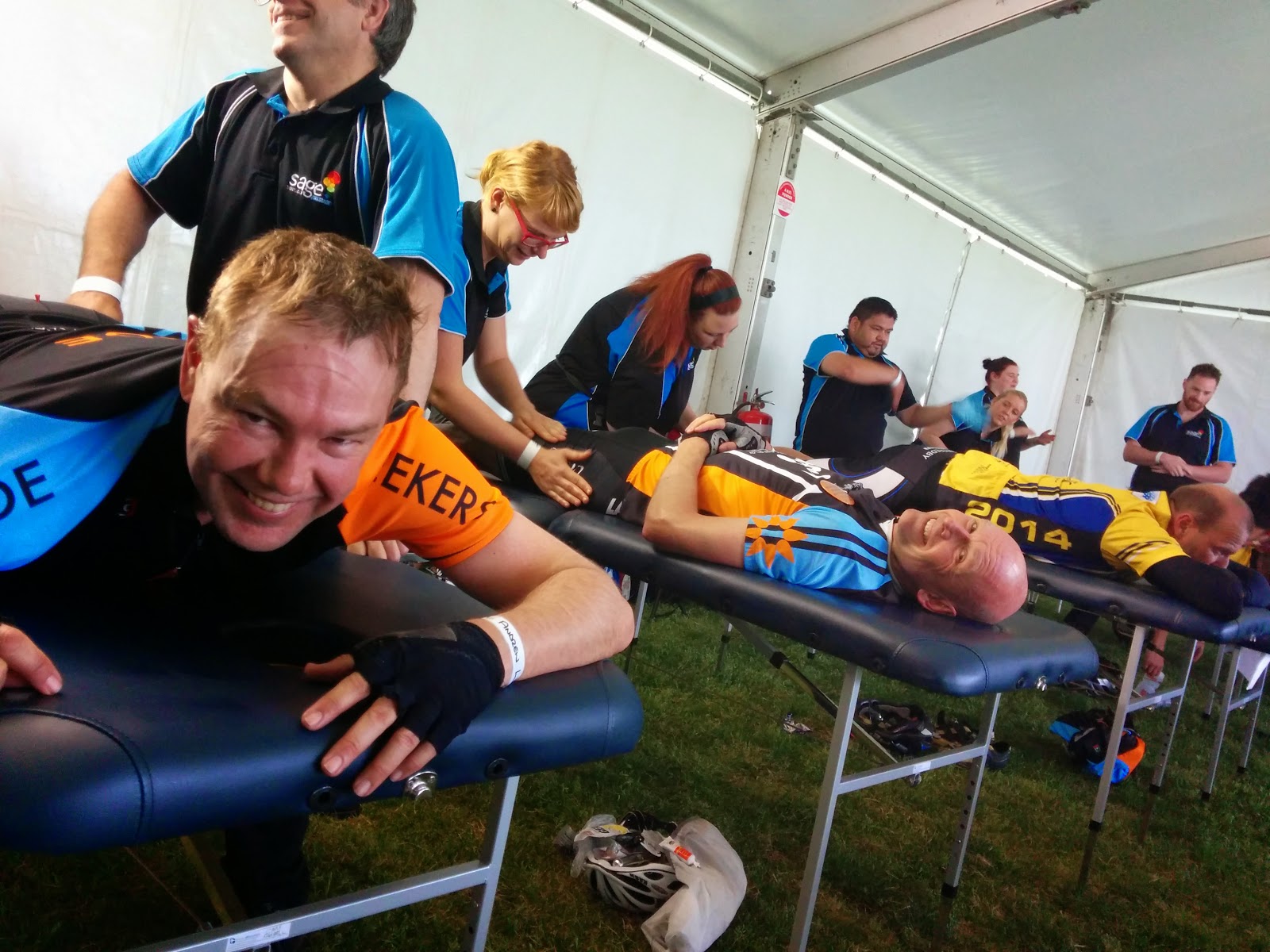 |
| Andrew enjoying his massage |
 |
| Damien having his leg pulled |
Leaving the tent we found Mike sitting on the bench outside looking slightly shaken. He'd had a call telling him that one of our team, Mark Shackleton, had been knocked off his bike on the way down. Mark was heading to the Accident and Emergency department, apparently not too bad but having hit the road at something like 30km/h he wasn't in great shape.
I heard more details later in the evening. Mark had been riding on one of the long straight stretches of road on the peninsula that this year's course had taken, Roads with one lane in each direction and a narrow, course, gravel edge with a drop-off from the tarmac to the gravel. With local traffic and 90-100km/h speed limits and 1000+ riders this was a difficult section to ride. As I understand it, Mark was with a small group and was just finishing overtaking a rider as a car behind the group was beeping its horn. As Mark had pulled left having passed the last rider, the car went by and clipped Mark, sending him tumbling off his bike. Luckily there were witnesses who saw the incident and took the plate of the car as it sped on. Mark has a fractured humerus but is otherwise reasonably OK. Mark is a winner of the Life Scientist of the Year award, is at the forefront of Cancer Research and was riding selflessly for others and committing no road offence. If this was a deliberate or reckless act as alleged by witnesses, I can't imagine what would have been going through the driver's mind at the time. Mark is characteristically reasonable, as you can read and hear in the 3AW interview here. The car and driver have been traced and we hope that the legal system will do everything that it should.
Not yet knowing the full story, we four rode back across the peninsula to our homes for the night in Somers. The roads were the same single lane each way, 100km/h limit, with impatient, and sometimes aggressive traffic as we rode, single file, the 30 or so kms to Somers. One example was the shouting "bird" gesture flicking ute driver going in the opposite direction, who took offence at the sight of four cyclists daring to use the road. Thankfully we left the busy roads intact and enjoyed the last few kilometres to Somers, cycling as a well drilled team of four.
A great evening started with a welcome shower followed by lots, and lots, of really good food and cold beer, and finishing with drinks around Ben Brady's holiday home fire and a near instant sleep.
Here's the Strava map of the day.
Here's the Strava map of the day.
Day 2: Somers - Arthurs Seat - Mt Martha - Melbourne - Home: 125km
Somers is a delightful place to stay, but was some 30km of busy roads from the start. Some opted to get a lift back to the start, others opted to ride on quieter roads from Somers, a few via Arthurs Seat (a local hill), and other more direct to rejoin the ride around Mt Martha. I joined the hill climbers of Ben, Damien, Andrew and David, with Sharon and Darren riding with us until they headed off to the main route.Arthurs Seat has a steep side and less steep side. Our approach meant riding up the less steep part, and then down the steep part. A pleasant climb, and one where I had an amusing discussion with a senior rider (probably in his 70s or 80s), having ridden past him on my way to the T Junction and exchanging cheerful good-mornings, I waited for the others. A minute or two later he rides past me asking if I was OK - I think he thought I might have been going to hard... still it was fun telling the others that they were being outpaced by someone 20+ years their senior. Apparently he does the ride every weekend - good on him.
Here's a photo of us at the top next to someone else's nice bike, I'm sporting last year's shirt, the rest are in the latest version...
We then rode along the beach front boulevard, taking the coast road to Mt Martha. Along the way we practised a group rotation (outer right riders are gradually passing those on the left, pull over left as you get to the front and then relax as the others go past you. Repeat).
We joined the main group somewhere near a pit-stop, refuelled with bars and water we climbed away from the Mt Eliza National Park - a tough climb for some of the field less used to riding.
From there it was mostly down-hill and then flat to the lunch stop at Mordialloc College - who's open grass field offered little shade, but food and a welcome respite. There we regrouped to form a team of 11 Shade Seekers.
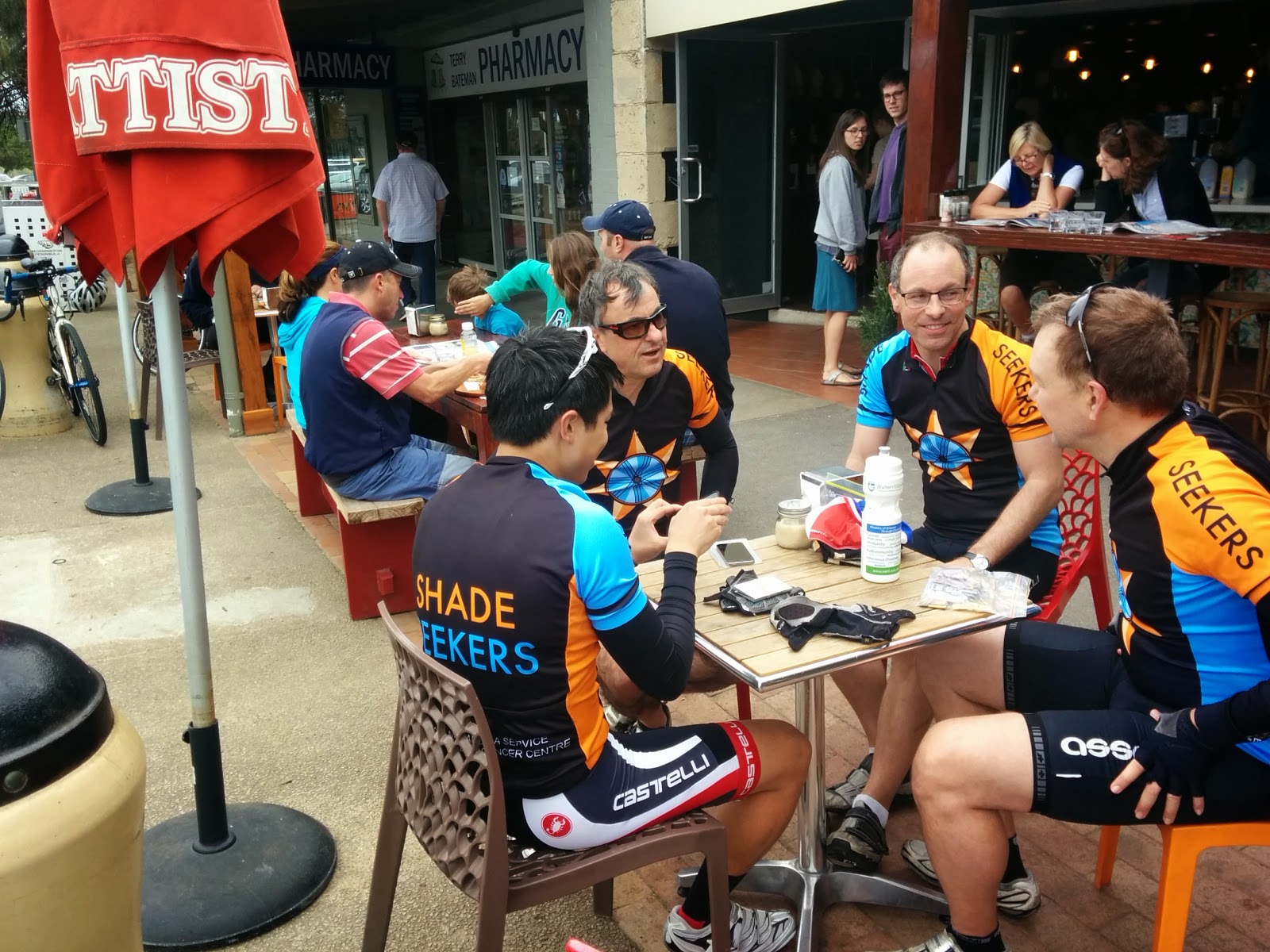 |
| Mt Martha Coffee Break - Double Shot 3/4 lattes all round |
We joined the main group somewhere near a pit-stop, refuelled with bars and water we climbed away from the Mt Eliza National Park - a tough climb for some of the field less used to riding.
From there it was mostly down-hill and then flat to the lunch stop at Mordialloc College - who's open grass field offered little shade, but food and a welcome respite. There we regrouped to form a team of 11 Shade Seekers.
 |
| All screened up in the Sun |
From lunch we rode as a group of 11. Sticking together all the way to the finish line where we decided to cross in 3-4-4 formation - a classic for soccer, less so for cycling!
Here's a shot from the finish:

And here's the Strava map of Day 2
So there you have, the end of this years ride. I'm left uncertain as to whether to sign up again. I think I may well do so, a close friend and Shade Seeker rider was diagnosed with prostrate cancer just before the ride. He is early on his journey but the post-operation signs seem good and he, and his daughter, want to ride next year. I know I'd like to be there with them.
Look after yourselves and those around you and keep your eye (and mind) open for ways to enrich your story.
Here's a shot from the finish:
And here's the Strava map of Day 2
So there you have, the end of this years ride. I'm left uncertain as to whether to sign up again. I think I may well do so, a close friend and Shade Seeker rider was diagnosed with prostrate cancer just before the ride. He is early on his journey but the post-operation signs seem good and he, and his daughter, want to ride next year. I know I'd like to be there with them.
Look after yourselves and those around you and keep your eye (and mind) open for ways to enrich your story.
John.
Subscribe to:
Posts (Atom)